C56 · Unit C7 Differential equations
Slope-field interpretation with explicit coordinates
CoreReview editionNot yet human-reviewed
- Time
- About 45 minutes, untimed
- Course framework reference
- AP 7.3–7.4
- Builds on
- Part of
Progress on this lesson counts in every pathway listed.
Understand the idea
A slope-field segment at (x,y) records F(x,y) for y minutes equals F(x,y). For an autonomous equation F(y), all segments on a horizontal row have equal slope. For F depending only on x, vertical columns share slope. A zero-slope curve is not necessarily a solution: a moving curve of horizontal segments need not itself be horizontal.
Worked example
For y minutes equals x minus y, horizontal segments lie on y equals x, but y equals x is not a solution because its derivative is 1 while x minus y equals 0. For y minutes equals 1 minus y, the row y equals 1 is both horizontal and an equilibrium solution.
Explore the mathematics
Slope-field interpretation with explicit coordinates
Follow local slopes with Euler steps and compare with an exact solution.
Scroll sideways to see the full diagram.
Predict before continuing
The slope equals the current height. Predict the first step.
Read the complete explanation
- The slope equals the current height. Predict the first step.
- Use the starting slope 1: new y = 1+h×1.
- Update the slope at each new point; a constant slope for the whole journey would be wrong.
- Euler uses tangent segments. Here the exact curve is convex, so forward Euler underestimates; smaller h improves this example.
Scroll sideways to view the full diagram.
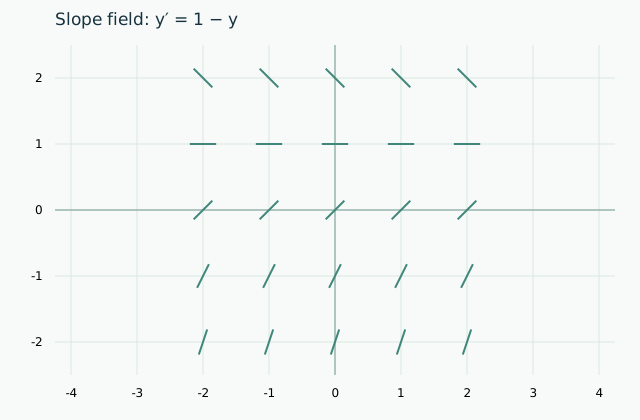
Slope field for y prime equals 1 minus y. Every horizontal row has the same slope.
| y | Slope at every x |
|---|---|
| −2 | 3 |
| −1 | 2 |
| 0 | 1 |
| 1 | 0 |
| 2 | −1 |
A common misconception
Distinguish a nullcline, where derivative is zero, from a solution curve that obeys all the slopes along it.
Investigate and explain
Draw rows of slope segments for y minutes equals 1 minus y, then sketch three solutions with different initial heights.
Identify one step in the worked example, name the mathematical fact that permits it, and state its domain conditions.